
Foreign Secretary Shyam Saran said enough time was required to allow diplomatic efforts to resolve Iran's nuclear issue and India was encouraging the European Union and Russia to help in accomplishing this.
Foreign Secretary Shyam Saran said enough time was required to allow diplomatic efforts to resolve Iran's nuclear issue and India was encouraging the European Union and Russia to help in accomplishing this.

The controversy-hit Kudankulam Nuclear Power Project will start its production by the first week of December and the first tranche of entire 1,000 MW of power will go to Tamil Nadu, Union minister V Narayanasamy said.

It is important to protect fissile material from extremists in Pakistan more than nuclear bombs because the latter has multi-layer security unlike the former, a senior Pakistani nuclear expert said on Saturday.
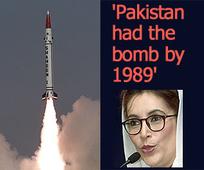
'Not only a stockpile but bomb components existed and it was only a question that we put them together or did \n\n not put them together.' Benazir Bhutto, in an exclusive interview.
'With China investing in Iran's energy sector, India cannot afford to lag behind.'
"These guys are now three for three as supplier to the biggest proliferation problems we have," a senior official in Washington told The New York Times, referring to previously reported Pakistani aid to the nuclear programmes of North Korea and Iran.

'The biggest lacuna in this agreement is it is called 'full civil nuclear cooperation agreement.' Actually, it is anything but full.'

With the launch of the first indigenous aircraft today, India will join a club of nations like the United States, Russia, China, the United Kingdom and France that possess nuclear-powered submarines
Noting that Iran's statement are often based on politics rather than physics, the White House has said it does not believe in Iranian President Ahmadinejad's latest statement on Tehran's capability to produce highly enriched uranium.
As the stand-off between Iran and the West continues over its nuclear programme, the United States has said India should use its 'influence' to convince the Iranian leadership to accept the 'one of the most reasonable' and 'perfectly plausible' proposal of low enrichment uranium.
India on Friday joined the United States in voting against Iran in a resolution passed by United Nations atomic watchdog IAEA censuring the Islamic nation over its controversial nuclear programme and demanding that it stop uranium enrichment.
In an unusual declaration ahead of the start of the G-20 Summit, Obama, flanked by President Nicholas Sarkozy of France and Premier Gordon Brown of Britain, announced they had detailed information that Iran is building a secret uranium enrichment facility near Qom, 160 km south of Tehran, for the past few years, which is not consistent with its energy needs.
State Department's Deputy Spokesman Tom Casey made this observation on Monday when asked whether the US has any concerns about Ahmadinejad proposed visit to New Delhi and whether there had been any message sent to India about the proposed meetings. Casey said it's up to every country to determine for itself how it's going to organise its bilateral relations.
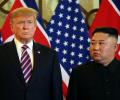
'Despite much hype of optimism, everyone went home empty-handed without a clear picture where they are heading in the future,' notes Dr Rajaram Panda.
Bharatiya Janata Party and Communist Party of India-Marxist members on Friday voiced concern in the Lok Sabha over efforts by the US and other industrialised nations to curb enrichment and reprocessing technology to India and demanded a statement by Prime Minister Manmohan Singh to clarify the situation.
India on Monday asserted its "entire nuclear technology has been developed indigenously and action consistent with responsible behaviour."\n
Russia and China on Friday signed a US$ one billion deal under which Moscow would build a nuclear fuel enrichment plant and deliver uranium to Beijing as the two strategic partners condemned the United States for its proposed missile defence plans.
IAEA director general Muhamad ElBaradei expressed the hope for a long-term comprehensive agreement, which would allow for the development of relations and cooperation with Iran.
Ahead of the meeting of the Nuclear Suppliers Group, India has said it will not accept the waiver from the 45-nation grouping if the 'red lines' set by it are crossed. National Security Adviser M K Narayanan made it clear that inclusion of any clause on testing, periodic review or denial of enrichment and reprocessing technology in the text of the NSG waiver would be unacceptable and hoped a way around these issues would be found through diplomatic efforts.
However, there would be some exceptions such as equipment meant for light water reactors and low-enriched uranium when it is incorporated in assembled nuclear fuel elements for such reactors.

The consideration by the then Indian Prime Minister was being made when the US was in an advanced stage of providing its fighter jets F-16 to Pakistan
Maintaining that the US and its allies are still leaving the door open for diplomacy, Rice reiterated that Iran will have to stop its nuclear programme before negotiations can begin.

He said the US will apply other punitive measures if Tehran does not give up its reported goal of developing nuclear weapons.
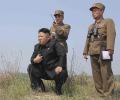
'Hardliners who are against denuclearisation may be working secretly on North Korea's nuclear activities, despite official claims that dismantling its nuclear arsenal has already begun.'' 'Does it mean that Kim does not have full control over the military,' asks Dr Rajaram Panda.

Putin is looking beyond the current regime in Kyiv. Of course, if the Western military assistance to Kyiv continues in any form, Washington knows that Russia will regard it as a hostile act and there will be severe consequences, predicts Ambassador M K Bhadrakumar.

'The onus is now on China to explain to the world why it feels Pakistan should accompany India on the question of NSG Membership!! China's not so covert help for Pakistan's nuclear weapons and ballistic missile programmes will stand exposed,' says former ambassador G Parthasarathy.

The White House has warned lawmakers that tightening sanctions on Iran could push the US on a "march to war" and derail a diplomatic push to limit Tehran's nuclear programme.
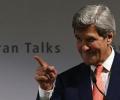
The deal with Iran does not address any of the major issues thrown up by Tehran's ambitions, says Claude Smadja.

'I would urge my Indian friends to look at how significant the overall support was.'

Meanwhile, the test drew strong criticism from North Korea's neighbours and the West which warned of a robust response to its "grave provocations".

Asserting that it will continue to engage Iran in bilateral economic activities, India on Thursday said any issue that Iran has with other parts of the world should not impede "legitimate economic interaction" of the two countries.

The implications of the interim deal between Iran and the world's big powers go far beyond the nuclear programme, says Nitin Pai

'An ardent advocate of nuclear disarmament, Obama may even be secretly heaving a sigh of relief that the NSG is unlikely to reach unanimity of opinion on India's candidature,' says Ambassador M K Bhadrakumar.

The possibility of a deal between Iran and the world on its nuclear programme has some perils but much promise for India, says Uday Abhyankar

Trump said the sanction will deny the Iranian Supreme leader access to financial instruments.
